About the Zebra Waxbill
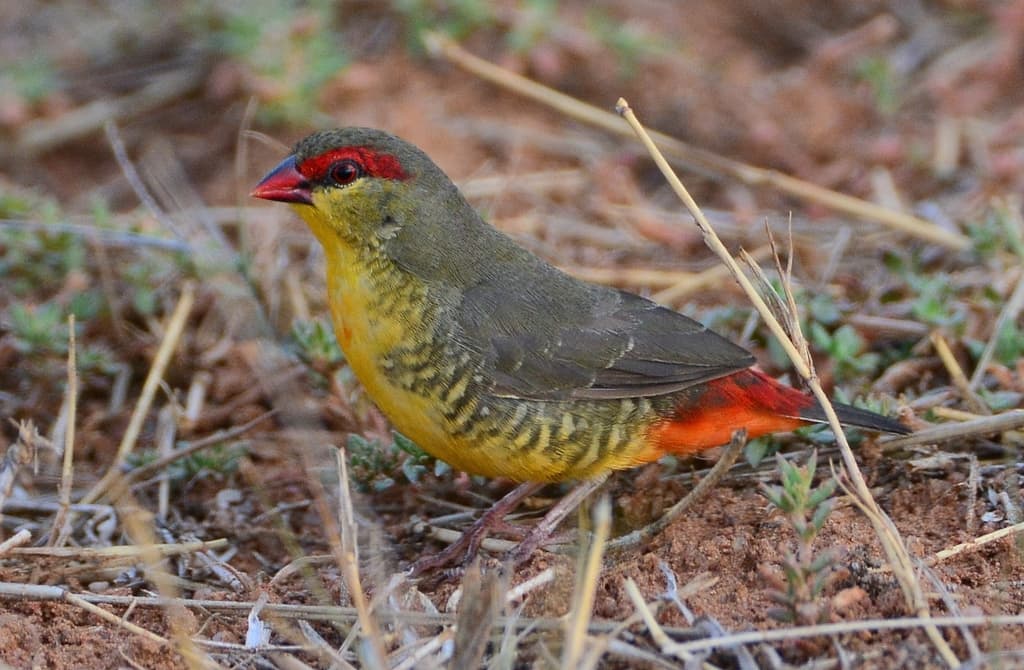
The orange-breasted waxbill (Amandava subflava), also known as the zebra waxbill, is a small (approximately 9 cm long) sparrow-like bird with a reddish iris, orange breast, red bill and dark olive-green plumage. The male has a red rump, dark bars on the whitish flank and a scarlet eyebrow stripe. The female is duller and smaller than male; it also lacks the male's red eyebrow. The orange-breasted waxbill is found in grassland and savannahs south of the Sahara in Africa. It has an estimated global extent of occurrence of 10,000,000 km2. This species is also introduced to other countries, e.g., Kuwait. Its diet consists mainly of seeds, insects and shoots. The female usually lays between four and six eggs in an oval-shaped nest made from grass.
Source: Wikipedia
Classification
- Scientific name
- Amandava subflava
- Family
- Waxbills and Allies
- Order
- Passeriformes
Similar species
Other members of the waxbills and allies family recorded in North America — a useful place to start if you are not certain of your identification.
- African Firefinch Lagonosticta rubricata
- African Silverbill Euodice cantans
- Black-and-white Mannikin Spermestes bicolor
- Black-rumped Waxbill Estrilda troglodytes
- Blue-capped Cordonbleu Uraeginthus cyanocephalus
- Bronze Mannikin Spermestes cucullata
- Chestnut Munia Lonchura atricapilla
- Common Waxbill Estrilda astrild
- Crimson-rumped Waxbill Estrilda rhodopyga
- Cut-throat Amadina fasciata
- Diamond Firetail Stagonopleura guttata
- Double-barred Finch Stizoptera bichenovii
Know when the Zebra Waxbill turns up near you
How rare bird alerts work →Gear for spotting Zebra Waxbill
Optics
Best Binoculars for Beginners
You don't need to spend a fortune. These four pairs will get you birding confidently on day one.
8 min readRead guide
Cameras
Cameras for Bird Photography
From phone adapters to dedicated rigs, here's what actually works for capturing birds in the field.
12 min readRead guide