Back to Field Guide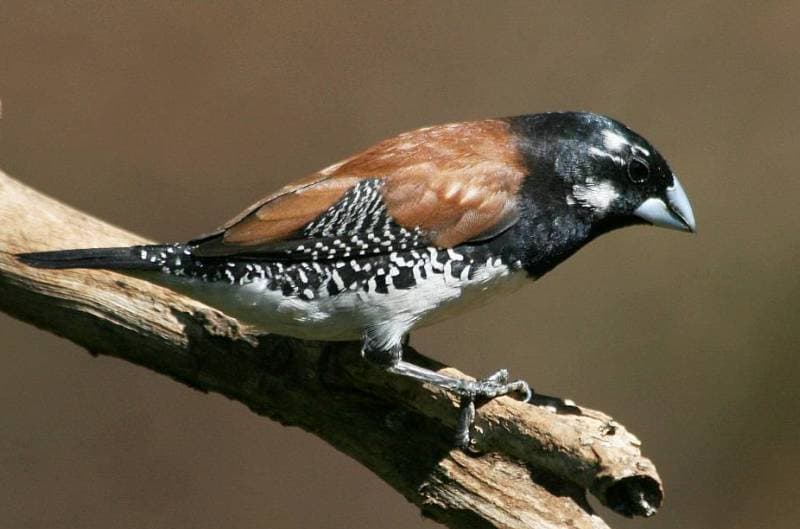
Black-and-white Mannikin
Spermestes bicolor
Range & Recent Observations
Last Spotted Near You
About the Black-and-white Mannikin
The black-and-white mannikin (Spermestes bicolor) also black-and-white munia or red-backed mannikin, is a species of estrildid finch, widely present throughout sub-Saharan Africa. It has an estimated global extent of occurrence of 4,200,000 km2 (1,600,000 sq mi). It is found in moist savanna and subtropical or tropical moist lowland forest habitat. The status of the species is evaluated as least concern. They are seedeaters, but are known to feed on algae. The black-and-white mannikin was formally described in 1843 by the British zoologist and collector Louis Fraser from a specimen collected near Cape Palmas in Liberia. He placed the species in the genus Amadina and coined the binomial name Amadina bicolor.
Source: Wikipedia
Classification
- Scientific name
- Spermestes bicolor
- Family
- Waxbills and Allies
- Order
- Passeriformes
Similar species
Other members of the waxbills and allies family recorded in North America — a useful place to start if you are not certain of your identification.
- African Firefinch Lagonosticta rubricata
- African Silverbill Euodice cantans
- Black-rumped Waxbill Estrilda troglodytes
- Blue-capped Cordonbleu Uraeginthus cyanocephalus
- Bronze Mannikin Spermestes cucullata
- Chestnut Munia Lonchura atricapilla
- Common Waxbill Estrilda astrild
- Crimson-rumped Waxbill Estrilda rhodopyga
- Cut-throat Amadina fasciata
- Diamond Firetail Stagonopleura guttata
- Double-barred Finch Stizoptera bichenovii
- Gouldian Finch Chloebia gouldiae
Know when the Black-and-white Mannikin turns up near you
How rare bird alerts work →Gear for spotting Black-and-white Mannikin
Optics
Best Binoculars for Beginners
You don't need to spend a fortune. These four pairs will get you birding confidently on day one.
8 min readRead guide
Cameras
Cameras for Bird Photography
From phone adapters to dedicated rigs, here's what actually works for capturing birds in the field.
12 min readRead guide