Back to Field Guide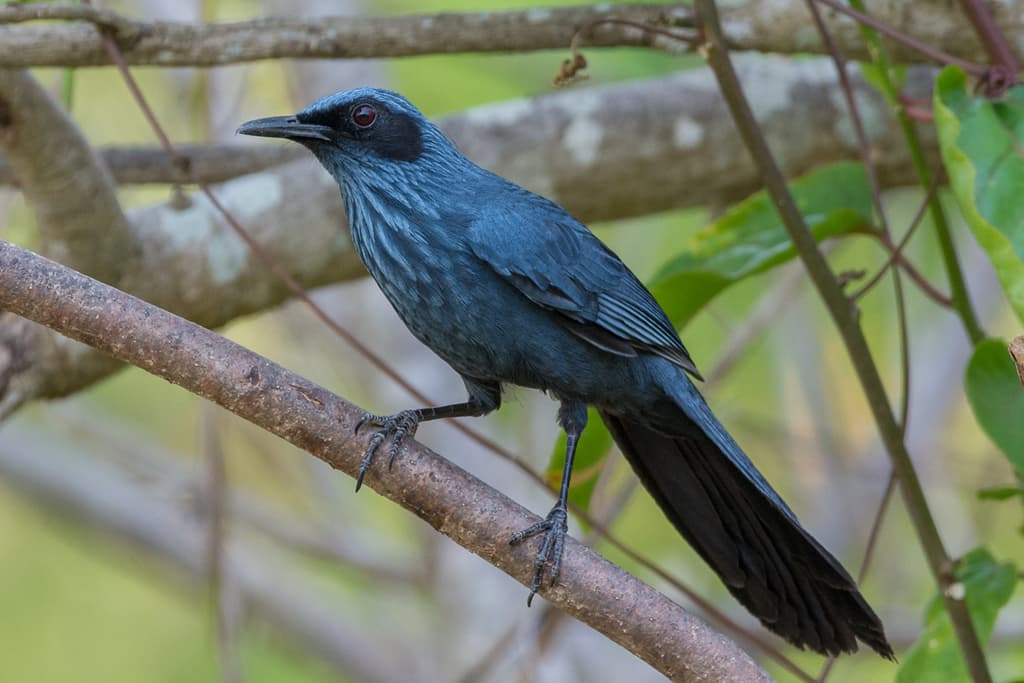
Blue Mockingbird
Melanotis caerulescens
Range & Recent Observations
Last Spotted Near You
About the Blue Mockingbird
The blue mockingbird (Melanotis caerulescens) is a species of bird in the family Mimidae. It is endemic to Mexico, but has occurred as a vagrant in the southern United States. Its natural habitats are subtropical or tropical dry forests, subtropical or tropical moist montane forests, and heavily degraded former forest. The blue mockingbird is uniformly blue on its back, tail, wings, head and underbelly. This color is a result of feather structure rather than pigment, and therefore can look gray in the shade. It has a black "mask" surrounding its reddish-brown eyes. It has a rather long, slightly graduated tail, and dark blue streaks over its breast. Its bill is long, thin and slightly curved, and its legs and feet are black.
Source: Wikipedia
Classification
- Scientific name
- Melanotis caerulescens
- Family
- Mockingbirds and Thrashers
- Order
- Passeriformes
Similar species
Other members of the mockingbirds and thrashers family recorded in North America — a useful place to start if you are not certain of your identification.
- Bahama Mockingbird Mimus gundlachii
- Bendire's Thrasher Toxostoma bendirei
- Black Catbird Melanoptila glabrirostris
- Blue-and-white Mockingbird Melanotis hypoleucus
- Brown Thrasher Toxostoma rufum
- California Thrasher Toxostoma redivivum
- Cozumel Thrasher Toxostoma guttatum
- Crissal Thrasher Toxostoma crissale
- Curve-billed Thrasher Toxostoma curvirostre
- Gray Catbird Dumetella carolinensis
- Gray Thrasher Toxostoma cinereum
- LeConte's Thrasher Toxostoma lecontei
Know when the Blue Mockingbird turns up near you
How rare bird alerts work →Gear for spotting Blue Mockingbird
Optics
Best Binoculars for Beginners
You don't need to spend a fortune. These four pairs will get you birding confidently on day one.
8 min readRead guide
Cameras
Cameras for Bird Photography
From phone adapters to dedicated rigs, here's what actually works for capturing birds in the field.
12 min readRead guide